
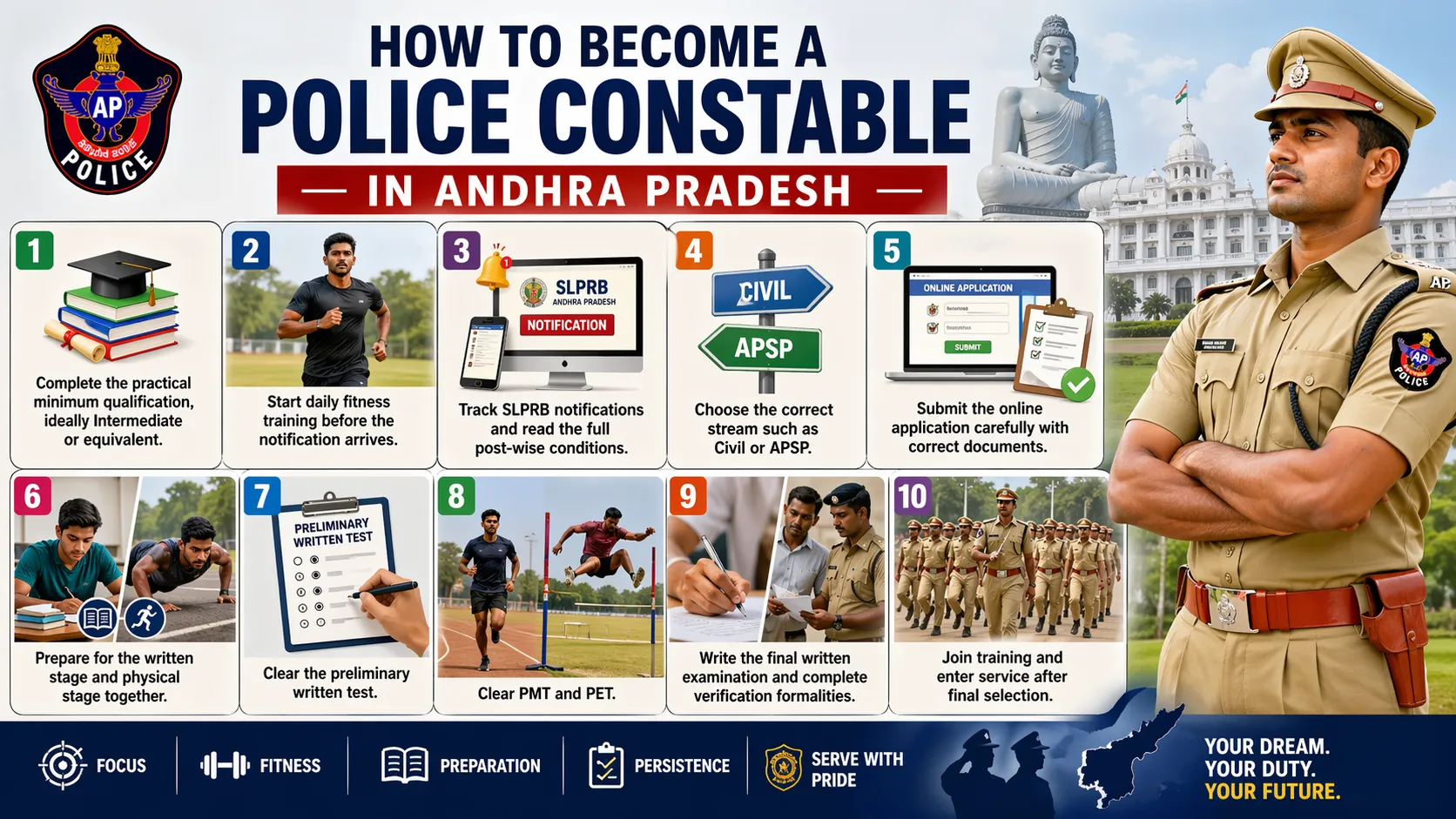
To become a police constable in Andhra Pradesh, the usual route is to apply through a recruitment notification issued by the Andhra Pradesh State Level Police Recruitment Board (SLPRB), meet the educational, age, and physical standards, clear the written and physical stages, and then complete training after selection.
The Police Constable post is not a single generic role. Candidates commonly see direct recruitment pathways such as (i) SCT Police Constable (Civil) and (ii) SCT Police Constable in APSP, and the work pattern, physical expectations, and final selection logic can differ slightly between these streams.
What a Police Constable in Andhra Pradesh actually does
A police constable in Andhra Pradesh is an entry-level uniformed field role. The job usually combines law-and-order support, station-related duties, patrol work, public dealing, security deployment, and unit-based operational responsibilities.
The daily work can differ depending on the stream, posting, and unit. Civil constable roles are usually more public-facing, while APSP roles are commonly more force-oriented and deployment-heavy.
| Post type | Typical work pattern |
|---|---|
| Civil Police Constable | Station support, beat duty, patrol, public order support, crowd control, security duty, and local field assignments |
| APSP Constable | Battalion-style duties, disciplined force deployment, bandobast, reserve support, and physically demanding field assignments |
Before choosing this path, candidates should be clear about the working reality:
- Duty hours are not always fixed and can include shifts, nights, holidays, and emergency deployment.
- The job requires discipline, physical readiness, and the ability to work within a chain of command.
- Public dealing can be stressful, especially during law-and-order, traffic, security, or crowd-management duties.
- Posting type can change the lifestyle significantly, especially between station-linked and battalion-style service.
This career usually suits candidates who are comfortable with uniformed field service, structured discipline, and long-term government employment.
Main pathways to become a Police Constable in Andhra Pradesh
The core entry pathway is direct recruitment through Andhra Pradesh State Level Police Recruitment Board (SLPRB), but there can be more than one constable stream within the same cycle.
| Pathway | Who it suits | Main distinction |
|---|---|---|
| Stipendiary Cadet Trainee (SCT) Police Constable (Civil) | Candidates seeking general police field and station-linked service | Usually open to men and women when notified; public-facing policing role |
| Stipendiary Cadet Trainee (SCT) Police Constable (APSP) | Candidates ready for stronger battalion and deployment-oriented service | Armed police style work pattern; physical service reality can be tougher |
| Special category entry within notified recruitment | Candidates claiming notified reservation or quota categories | Same recruitment, but document proof and eligibility route become especially important |
The safest planning strategy is to first target broad eligibility for constable recruitment, then read the exact post code details when the notification opens.
Who can realistically apply for this Police Constable career path
This career path can be realistic for you if you want an entry-level state government uniformed job in Andhra Pradesh and you are ready to prepare for both the written exam and the physical stages.
You are usually a strong fit for this route if the following points describe you:
- You are completing or have already completed Intermediate or an equivalent qualification and want to enter government service at the constable level.
- You are comfortable with field-based work instead of expecting a fixed desk or office routine.
- You can follow a disciplined daily routine for fitness, written preparation, and document readiness.
- You are willing to work within a chain of command and handle public-facing duties, pressure situations, and irregular duty timings.
You should think more carefully before choosing this route if any of these points apply to you:
- You want a predictable office-based job with fixed working hours.
- You are not prepared to train seriously for running, stamina, and physical test performance.
- You are interested in government work but not in uniformed field service.
- You would prefer a less physically demanding or less publicly stressful career path.
If you are still unsure, ask yourself one practical question: are you ready for a career that combines physical discipline, written-exam preparation, public duty, and long-term service structure? If the answer is yes, this can be a realistic pathway for you.
Educational, age, and category-based eligibility route
If you are planning for Andhra Pradesh police constable recruitment, the safest target is to complete Intermediate or an equivalent qualification and then check the exact notification for age, category, and post-specific conditions. This is the most practical route for most candidates.
Based on the previous major Andhra Pradesh Police Constable recruitment notification issued in November 2022 for Post Codes 21 and 23, the educational rule was more specific than a simple 12th-pass line. For most candidates, the required qualification was Intermediate or an equivalent examination recognised by the State Government. For SC and ST candidates, the same notification allowed a relaxation route: they could qualify if they had passed SSC or its equivalent and had studied Intermediate and appeared for both first-year and second-year Intermediate examinations. You should treat this as previous-cycle guidance, not as an automatically confirmed rule for every future recruitment cycle.
| Eligibility area | What the previous major cycle said |
|---|---|
| Educational qualification | Intermediate or equivalent for the standard route |
| SC/ST relaxation route | SSC or equivalent plus study of Intermediate and appearance in both first-year and second-year examinations |
| Who could apply for Civil Constable | Men and women were eligible for Post Code 21 |
| Who could apply for APSP Constable | Only men were eligible for Post Code 23 |
| Minimum age | 18 years |
Based on the same previous cycle, age limits were not identical for every applicant type. A Home Guard candidate who was local to Andhra Pradesh, working in the AP Police Department, and had completed the required service condition could apply up to 32 years. The notification also gave upper-age relaxation in certain cases, including up to five years for EWS, BC, SC, and ST candidates, limited age benefit for eligible AP State Government employees, service-linked relaxation for ex-servicemen, and separate widow or divorcee-related provisions where applicable. These are useful planning signals, but they are still previous-cycle details and must be confirmed again when the next notification is released.
- Your date of birth is usually checked from the SSC or equivalent certificate, so that record must be correct.
- If you want to claim reservation, age relaxation, or a special category, your supporting certificates must match the notification requirements.
- If you are in Class 10 now, the safer long-term route is to plan for Intermediate completion instead of depending on a relaxation that may not apply later.
Physical Standards and Fitness
If you are serious about becoming a police constable in Andhra Pradesh, you should treat the physical stage as a core part of recruitment, not something to think about after the written exam. In practice, many candidates lose their chance here even after clearing the written stage.
Based on the previous major Andhra Pradesh Police Constable recruitment cycle, candidates first had to cross the written shortlisting stage and then face Physical Measurement Test (PMT) and Physical Efficiency Test (PET). The notification laid down specific physical measurements and physical efficiency events. For men, this included height standards, chest measurement where applicable, and physical events such as running and long jump. For women candidates in the Civil constable route, the applicable physical standards and events were different from the men’s standards. APSP and Civil pathways also differed in who could apply and how physically demanding the service route was.
| Area | What you should understand |
|---|---|
| Physical Measurement Test (PMT) | This stage checks whether you meet the required body measurements for the post, such as minimum height and, where applicable, chest standards. It is a qualifying filter. If your measurements do not match the notification rules for your post, category, and gender, you are stopped at this stage and do not move to the next round. |
| Physical Efficiency Test (PET) | This stage checks whether you can actually perform the required physical events within the prescribed standard. In previous Andhra Pradesh constable recruitment cycles, this typically meant event-based tests such as running and long jump, with different standards for men and women depending on the post. It is not enough to look fit or be generally active. You must complete the exact events in the way the notification requires. |
| Civil vs APSP | Civil constable and APSP constable routes are not physically identical in practical service reality, so choose your target route carefully. |
| Preparation timing | If you wait until the hall ticket stage to begin running practice, you may already be too late. |
If you are preparing for this route, your fitness plan should include:
- regular running practice with timing-based tracking, not casual exercise
- leg strength and explosive movement work for events such as long jump
- stamina building, recovery discipline, sleep, and hydration
- body-weight control and injury prevention, especially if you are restarting fitness after a long gap
The safest mindset is this: you are not preparing to look fit, you are preparing to clear a measured elimination stage. A candidate with average academics but disciplined physical preparation can remain competitive. A candidate with good written preparation but weak PET readiness can still be eliminated before final selection.
Because physical standards and event details can change by notification, use the previous cycle only as a practical benchmark and always confirm the exact PMT and PET standards again when the next Andhra Pradesh constable notification is released.
Written Exam and what to prepare
The written stage usually tests basic but broad recruitment aptitude rather than deep subject specialization.
Based on the last major constable notification in Andhra Pradesh, the syllabus covered English, arithmetic, reasoning or mental ability, general science, history, Indian culture and national movement, geography, polity, economy, and current affairs. The final written stage mattered strongly for merit, while the role of preliminary marks depended on the recruitment structure.
- Arithmetic and reasoning need steady practice, not last-week revision.
- Current affairs and general awareness must be prepared consistently.
- Language comprehension matters because careless reading leads to avoidable marks loss.
- Candidates should prepare in the language and answer style allowed in the exam.
Step-by-step process from student to police constable
The cleanest route is to build eligibility first, then prepare for the recruitment cycle in an orderly way.
- Complete the practical minimum qualification, ideally Intermediate or equivalent.
- Start daily fitness training before the notification arrives.
- Track SLPRB notifications and read the full post-wise conditions.
- Choose the correct stream such as Civil or APSP.
- Submit the online application carefully with correct documents.
- Prepare for the written stage and physical stage together.
- Clear the preliminary written test.
- Clear PMT and PET.
- Write the final written examination and complete verification formalities.
- Join training and enter service after final selection.
This process sounds simple, but most mistakes happen in post selection, documents, cut-off date misunderstanding, and weak physical preparation.
Documents to keep ready and mistakes to avoid
Many candidates lose time not because they lack potential, but because they are careless with documents and form details.
- Keep SSC certificate ready for date-of-birth proof.
- Keep Intermediate or equivalent proof ready where applicable.
- Ensure category, EWS, and special category certificates are current and valid if you want to claim them.
- Keep local status or study certificates ready if the recruitment requires them.
- Use the same spelling of name and consistent parent details across records.
Common mistakes include choosing the wrong post, assuming reservation without valid proof, uploading poor-quality images, and ignoring the exact cut-off date for age or education. In police recruitment, document mismatch can block you even after preparation effort.
Salary, work-life reality, and what the career feels like after joining
This is a stable government career, but it is not an easy-pay government role.
A police constable in Andhra Pradesh can expect a structured state-government pay system with allowances and deductions, but the bigger question is whether you are suited to the service life. The job can involve night duty, festivals, crowd management, field deployment, emergency call-outs, and pressure from public-facing situations.
- Financial stability improves over long service, not only at entry.
- Posting location changes daily life and costs.
- Uniformed service brings discipline, social respect, and job security for many candidates.
- Stress management and family adjustment matter in the long run.
Career growth after joining as constable
Constable entry is not the end rank unless you treat it that way.
With service record, experience, departmental opportunities, and time in service, a constable can move upward through ranks such as Head Constable and Assistant Sub-Inspector. Ambitious candidates may also continue studying and prepare for higher police opportunities where eligible.
- Promotion is influenced by service rules, departmental procedures, and vacancies.
- Discipline and record matter in uniformed service progression.
- A stable start at constable level can still become a long-term police career.
When should you start preparing for this pathway
The best time to start is before the notification, not after it.
If you are in Class 11 or 12, begin building basic fitness and current affairs discipline early. If you have already completed Intermediate, start treating this like a two-track preparation cycle: one track for written exam basics and one for running, stamina, and physical event readiness.
- Early starters reduce injury risk because fitness improves gradually.
- Document readiness becomes easier when you are not rushing at the last minute.
- You also get time to compare constable versus SI or other state jobs realistically.
When you should consider a different route instead of constable entry
Constable entry is not the only police career path in Andhra Pradesh.
If you are a graduate with strong exam ability and you are aiming for a higher entry point, you may also compare Sub-Inspector recruitment or other uniformed state roles. If your physical profile does not fit constable standards, it may be wiser to explore office-based government careers instead of forcing a path that does not suit your body or preferences.
Main Andhra Pradesh police constable pathways
Please note that this is a planning table, not a substitute for the notification.
| Pathway | Typical qualification target | Work pattern | Key caution |
|---|---|---|---|
| SCT Police Constable (Civil) | Usually Intermediate or equivalent | Public-facing field and station duties | Read women eligibility, local rules, and final merit logic carefully |
| SCT Police Constable (APSP) | Usually Intermediate or equivalent | Battalion-style and stronger deployment reality | Do not underestimate physical service demands |
| Special-category entry within same recruitment | Depends on notification and valid certificates | Same recruitment but document-heavy validation | Wrong category claim can damage candidature |
What successful constable preparation must cover
Balanced preparation is more useful than over-focusing on one part of the process.
| Preparation area | What to do | Why it matters |
|---|---|---|
| Qualification and documents | Keep education, date-of-birth, category, and local records ready | Application or verification mistakes can block selection |
| Written exam | Cover arithmetic, reasoning, English, general studies, and current affairs | Written stages still control progression and merit |
| Physical readiness | Train running, stamina, speed, and jumping with measurable targets | PMT and PET eliminate many otherwise serious candidates |
| Notification reading | Understand post code, age cut-off, and reservation rules | Wrong assumptions lead to preventable rejection |
Official Links
-
SLPRB Andhra Pradesh
[Website]
Primary recruitment board website for Andhra Pradesh police recruitment. -
Andhra Pradesh Police
[Website]
Official police department website. -
APSP Official Website
[Website]
Useful for understanding the APSP side of service context. -
SLPRB AP Constable Notification PDF (2022 recruitment cycle)
[Notification]
Useful official reference for stable pathway guidance, post types, educational route, PMT, PET, and exam structure from a major recruitment cycle.
Frequently Asked Questions
The practical target is usually Intermediate or an equivalent qualification, though some recruitment cycles may provide specific relaxation routes for certain categories.
Yes, women can be eligible in some constable streams such as Civil recruitment when notified. You must check the exact post-wise notification because not every stream may be identical.
Yes. Recruitment usually includes written examination stages, but physical measurement and physical efficiency tests are also major parts of selection.
You need a workable level of written-exam preparation, but success also depends heavily on fitness, discipline, and correct document handling.
Civil constable work is usually more public-facing and station-linked, while APSP constable work is commonly more battalion-oriented and deployment-heavy.
For practical planning, you should aim to complete Intermediate because that is usually the standard route. Do not rely on category-based relaxation unless the active notification clearly applies to you.
Yes. Physical measurement and physical efficiency stages are decisive filters, and many candidates fail because they delay fitness preparation.
Major police constable recruitment in Andhra Pradesh is typically conducted by the State Level Police Recruitment Board, Andhra Pradesh.
Yes, a graduate can apply if the notification allows it, but such candidates may also compare Sub-Inspector or other higher-entry routes.
It can be a strong long-term state government career for candidates who are comfortable with field duty, discipline, public pressure, and uniformed service life.