
A Probationary Officer (PO) is one of the main officer-level entry routes into Indian banking for graduates. A PO is recruited as a management trainee or junior officer, trained in branch banking, customer service, credit, operations, compliance and business development, and then posted in a bank branch or office role.
The route usually depends on the recruiter. Public sector banks commonly recruit through IBPS PO or SBI PO, while some private banks use their own campus, direct hiring, training programme or internal assessment routes. Exact age limits, vacancies, exam pattern, fee, reservation rules and joining conditions should always be checked in the latest notification.
This career is suitable for candidates who want an officer-level banking job, are comfortable with targets and customer-facing work, and can handle transfers, documentation responsibility and long-term promotion competition.
What a Probationary Officer Actually Does
A PO is not only a desk officer or only a sales employee. The role combines customer handling, branch operations, business development, documentation, compliance and learning future managerial responsibilities.
- Opening and servicing accounts, deposits and banking products.
- Supporting loan processing and basic credit checks.
- Handling customers, complaints and service requests.
- Monitoring KYC, audit observations and operational accuracy.
- Learning how a branch is managed before moving into higher responsibility.
The first few years can feel demanding because a PO is expected to learn quickly while also meeting branch requirements.
Who Should Choose a Bank PO Career
This career suits candidates who want an officer-level banking job and are willing to accept transfers, customer interaction and target-linked responsibilities.
It may be a good fit if you:
- are comfortable with numbers, forms, customers and digital systems;
- can work under deadlines and daily branch pressure;
- want a stable long-term career with promotion opportunities;
- are willing to work in different locations depending on posting;
- can prepare seriously for competitive exams.
It may not suit someone who wants a fully remote job, a purely academic role, or a job with no customer or sales pressure.
Eligibility for Bank PO in India
The common eligibility base is graduation from a recognised university. However, age limits, category relaxations, nationality rules, final-year eligibility and document requirements vary by recruiter.
| Eligibility area | Typical requirement | Important caution |
|---|---|---|
| Qualification | Graduation in any discipline | Degree recognition and result date must match notification rules |
| Age | Usually a minimum and maximum age band | Cut-off date changes every notification |
| Nationality | Indian citizen or eligible category as notified | Read the exact wording in the advertisement |
| Category relaxation | Applicable as per rules | Certificate format and date can matter |
The safest approach is to read the eligibility section of the latest notification before applying, even if you qualified for a previous cycle.
Best Education Route for Becoming a PO
There is no compulsory banking degree for most PO exams. A BA, B.Com, B.Sc, BBA, B.Tech or other recognised graduation degree can work if the notification allows it.
Commerce and finance students may find banking awareness easier, while engineering and science students often perform strongly in reasoning, quant and data interpretation. Arts and humanities graduates can also compete well with disciplined preparation in maths, English and current affairs.
- During graduation: build English, arithmetic, reasoning and current affairs habits.
- After graduation: target full mock tests, banking awareness and interview readiness.
- For private banks: check whether the programme asks for minimum marks, course fee or bond conditions.
Main Exams and Entry Routes
The best-known PO routes are IBPS PO and SBI PO. These are national-level recruitment processes and normally require strong preparation across aptitude, English, banking awareness and interview skills.
- IBPS PO: common route for participating public-sector banks.
- SBI PO: separate recruitment for State Bank of India.
- Private bank PO programmes: may include aptitude tests, interviews and paid training routes.
- Internal promotion: clerical employees in banks may move to officer roles through internal channels, subject to service rules.
Candidates should not assume that every bank uses the same exam pattern. Always check stage-wise marks, cut-off rules and interview weightage.
Selection Process and Stages
Public-sector Bank PO selection is usually staged so that candidates are screened first through objective tests and then assessed for deeper knowledge, writing, personality and suitability.
- Preliminary exam: often a qualifying or screening stage focused on speed and accuracy.
- Main exam: usually broader and more scoring, with reasoning, data analysis, English, awareness and sometimes descriptive writing.
- Interview or group exercise: checks communication, judgement, banking awareness and role suitability.
- Document verification: confirms eligibility, category, date of birth and academic records.
- Medical and joining formalities: completed as per bank rules.
The final merit calculation differs by exam, so candidates must understand which stage carries final weight.
Preparation Strategy for Bank PO Aspirants
Bank PO preparation should combine concept clarity, speed, accuracy and regular test analysis. Reading more material is less useful than learning from mistakes in timed practice.
- Build arithmetic basics before attempting high-level data interpretation.
- Practise reasoning topics with timed sets and accuracy tracking.
- Read editorials and banking news to improve English and interview depth.
- Revise current affairs monthly, especially economy, banking and government schemes.
- Attempt mocks only when you also review wrong answers and skipped questions.
A balanced candidate prepares for mains and interview from the beginning, not only after clearing prelims.
Bank PO Salary, Allowances and Take-Home Reality
Bank PO salary is usually one of the main attractions of the role, but candidates should understand the difference between pay scale, gross salary and in-hand salary.
Public-sector banks generally provide scale-based pay with allowances such as DA, HRA and special allowance. Private banks may use different salary structures, performance-linked components or training-period stipends.
- Metro and non-metro postings can affect allowances.
- Deductions reduce in-hand salary from gross salary.
- Perks and medical benefits vary by bank.
- Promotion brings higher responsibility as well as better pay.
Salary should be read along with transfer policy, workload and career growth, not in isolation.
Training and Probation Period
After selection, a PO usually goes through induction training and probation. This period helps the bank assess whether the candidate can handle real branch responsibilities.
- Training may cover banking products, operations, customer service, credit, digital banking and compliance.
- Branch exposure teaches practical work that is not visible in exam preparation.
- Probation may include assessments, performance review and reporting by seniors.
- Confirmation rules vary by bank and should be read in the joining terms.
Candidates should treat probation seriously because early habits in documentation, customer handling and compliance shape long-term reputation.
Work Profile, Transfers and Pressure Points
A PO job can be stable, but it is not a low-pressure job. Branch banking can involve customer queues, daily reporting, audit compliance, sales expectations and urgent operational issues.
Common pressure points include:
- meeting deposit, loan, insurance or product targets;
- handling customer complaints calmly;
- avoiding mistakes in KYC, cash-linked processes and documents;
- managing transfers and location changes;
- balancing business goals with compliance rules.
This is why the role suits candidates who want a structured career but can handle responsibility and public dealing.
Promotion Path After Joining as PO
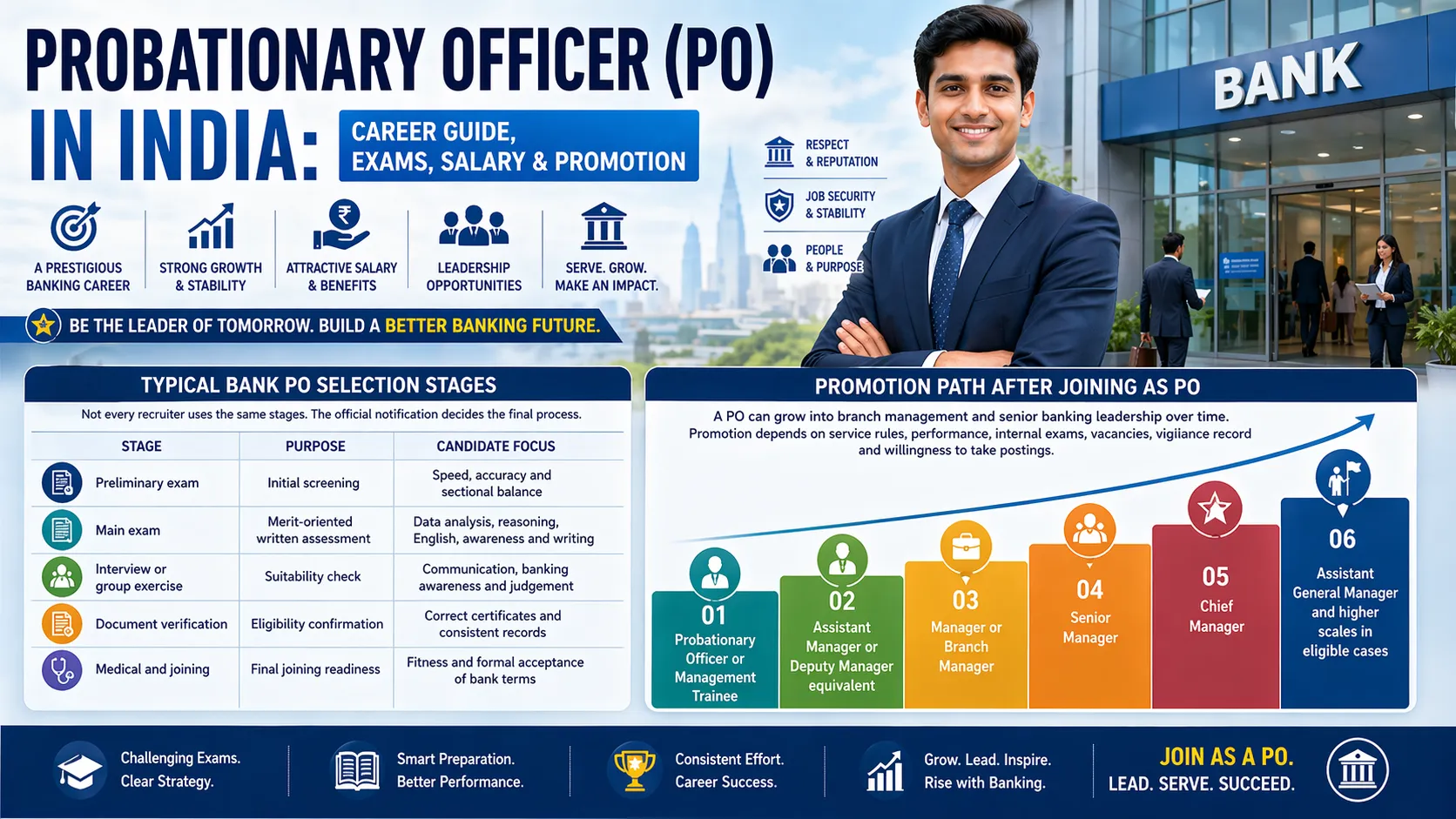
A PO can grow into branch management and senior banking leadership over time. Promotion depends on service rules, performance, internal exams, vacancies, vigilance record and willingness to take postings.
- Probationary Officer or Management Trainee
- Assistant Manager or Deputy Manager equivalent
- Manager or Branch Manager
- Senior Manager
- Chief Manager
- Assistant General Manager and higher scales in eligible cases
Promotion is not automatic only because of years served. Strong performance, clean service record and readiness for responsibility matter.
Public Sector Bank PO vs Private Bank PO
Public and private bank PO-style roles may look similar from the outside, but recruitment, salary structure, pressure, training and growth model can differ.
| Area | Public sector PO | Private bank officer route |
|---|---|---|
| Recruitment | Usually exam notification-based | Direct hiring, campus route or bank programme |
| Salary | Scale-based with allowances | Bank-specific CTC and variable components |
| Work pressure | Operations plus business targets | Often stronger sales and relationship targets |
| Transfers | Common across regions | Depends on bank and role |
| Growth | Promotion policy and internal processes | Performance and role mobility driven |
Candidates should compare both routes based on job culture, not only salary figures.
Common Mistakes Bank PO Aspirants Should Avoid
Many candidates lose time because they prepare without understanding the actual exam and job route.
- Preparing only for prelims: mains and interview need deeper awareness and writing ability.
- Ignoring English: English affects both exam performance and interview confidence.
- Not checking notification details: age cut-off, degree date and document rules can change.
- Confusing gross and in-hand salary: deductions and posting affect actual take-home pay.
- Underestimating the job: branch work includes targets, customer pressure and compliance responsibility.
A serious aspirant plans for selection, joining and job success together.
Documents to Keep Ready
Document readiness matters because wrong details or missing certificates can create problems at verification even after clearing the exam.
- Class 10 certificate for date of birth proof.
- Graduation semester mark sheets and degree or provisional certificate.
- Government photo identity proof.
- Recent photograph and signature in the required format.
- Category, EWS, PwBD or ex-servicemen certificate where applicable.
- Name-change proof if records differ.
Use the exact certificate format asked in the notification when applying under a reserved category.
Long-Term Scope of a Bank PO Career
A PO career can develop into branch management, credit, risk, operations, treasury support, audit, digital banking, training or administrative roles depending on the bank and the officer’s performance.
The long-term value of the role is that it provides early exposure to banking customers, financial products, compliance and team management. This experience is useful even if a candidate later moves into private banking, NBFCs, insurance, fintech operations or regulatory exam preparation.
However, growth requires adaptability. Banking changes with digital products, compliance rules, customer expectations and business targets, so officers must keep learning after selection.
Bank PO Eligibility Summary
This is a general summary. Exact eligibility must be verified from the latest official recruitment notification.
| Area | Typical Requirement | What to Check |
|---|---|---|
| Qualification | Graduation from a recognised university | Degree recognition, result date and final-year rules |
| Age | Usually a defined minimum and maximum age band | Cut-off date and category relaxation |
| Experience | Usually not required for entry-level PO | Some private routes may prefer experience |
| Nationality | As specified in the official notification | Exact eligibility wording |
| Documents | Education, ID and category documents | Format, validity and name consistency |
Typical Bank PO Selection Stages
Not every recruiter uses the same stages. The official notification decides the final process.
| Stage | Purpose | Candidate Focus |
|---|---|---|
| Preliminary exam | Initial screening | Speed, accuracy and sectional balance |
| Main exam | Merit-oriented written assessment | Data analysis, reasoning, English, awareness and writing |
| Interview or group exercise | Suitability check | Communication, banking awareness and judgement |
| Document verification | Eligibility confirmation | Correct certificates and consistent records |
| Medical and joining | Final joining readiness | Fitness and formal acceptance of bank terms |
Public Sector PO vs Private Bank Officer Route
This comparison is broad. Individual banks may differ significantly.
| Factor | Public Sector PO | Private Bank Officer Route |
|---|---|---|
| Entry method | Competitive exam and interview | Direct hiring, campus route or bank programme |
| Salary structure | Scale-based pay plus allowances | Bank-specific CTC and incentives |
| Job security | Generally stronger formal service structure | Depends on performance and bank policy |
| Work pressure | Operations, compliance and business targets | Often sales and relationship driven |
| Growth path | Internal promotion scales | Performance-led role mobility |
Official Links
-
IBPS Official Website
[Exam Authority]
Use for IBPS PO and other IBPS banking recruitment notifications. -
SBI Careers
[Recruiter]
Use for SBI PO notifications, application links and results. -
Reserve Bank of India
[Banking Regulator]
Useful for understanding banking regulation and official banking-sector updates.
Frequently Asked Questions
The usual minimum qualification is graduation from a recognised university. The exact rules, including final-year eligibility and result-date requirements, depend on the latest recruitment notification.
In many major public-sector PO exams, graduates from any discipline can apply if they meet the age, nationality and other notification rules. Some private-bank programmes may add marks or course-specific conditions.
IBPS PO and SBI PO are the most important public-sector Bank PO routes. Candidates may also consider private-bank management trainee routes and related exams such as IBPS RRB Officer Scale I.
A PO in a public-sector bank is a public-sector banking job, but banks are not the same as traditional government departments. Private-bank PO or management trainee roles are private-sector jobs.
A PO handles branch operations, customer service, account-related work, loan processing support, compliance tasks, business development and training for future managerial responsibilities.
No. Salary depends on the bank, pay scale, allowances, posting location, deductions and revisions. Public-sector banks usually follow scale-based pay, while private banks may use CTC-based structures.
Many banks have a probation period of around two years, but the exact duration and confirmation rules depend on the bank’s service conditions and joining terms.
Yes. A PO can grow into branch manager and higher managerial roles through internal promotions, performance, service record, internal exams and vacancies as per bank policy.
Yes, self-preparation is possible if the candidate follows the syllabus, practises timed questions, takes mock tests, analyses mistakes and builds current affairs and banking awareness consistently.
Yes, it can be suitable for fresh graduates who want an officer-level banking career and can handle competitive exams, customer interaction, targets, transfers and responsibility.