
Best Career Path - India
Career guides, recruitment, exams, results
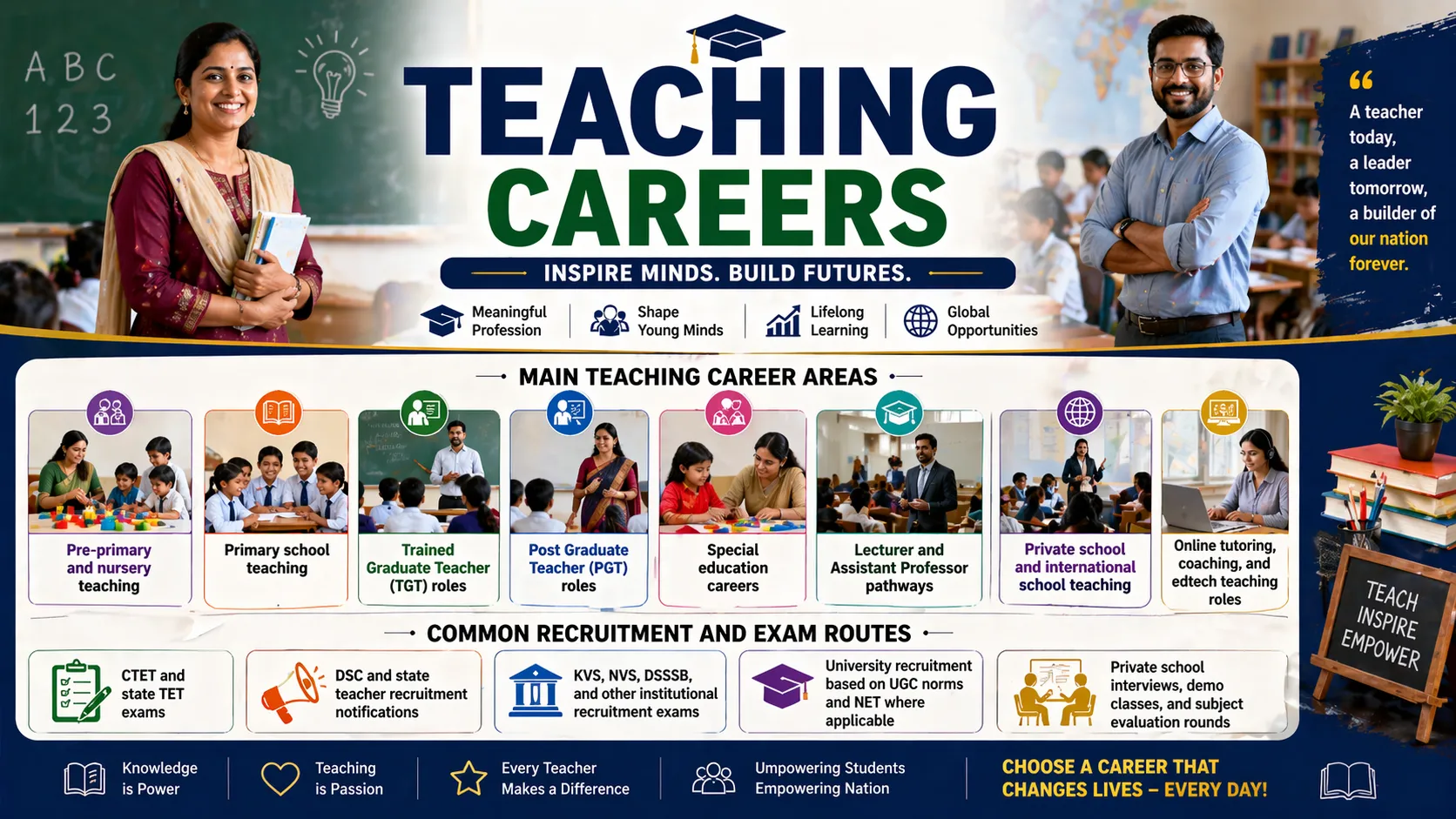
If you want to become a teacher in India, you should first know that teaching is not one single career path. It includes school teaching, college and university teaching, special education, academic coaching, online tutoring, and skill-based training roles across both government and private institutions.
Your route into teaching depends mainly on four things: the level you want to teach, your present qualification, the subject you want to teach, and whether you are targeting government jobs, private institutions, or both.
For example, the pathway to become a primary school teacher is different from the pathway to become a PGT, lecturer, or assistant professor. In the same way, the recruitment process for a government school teacher is very different from the hiring process in a private school or edtech company.
So if you are exploring teaching as a career, your first step should not be applying randomly. Your first step should be understanding which teaching level fits your qualification and long-term goals.
If you want to teach in schools, there are several distinct role types. These roles differ by class level, subject requirement, teacher-training qualification, and recruitment rules.
At the early-school and school level, the most common teaching roles include:
If you want to teach younger children, the route usually begins earlier, often with diploma-level or elementary-teacher qualifications. If you want to teach secondary or senior-secondary classes, graduation, postgraduation, and B.Ed-based eligibility become much more important.
You should also know that school teaching roles are not identical across all systems. Central schools, Navodaya schools, state government schools, aided schools, private schools, and international schools may all expect different qualifications, test scores, language ability, and classroom experience.
If you are aiming beyond school teaching, higher education opens another set of teaching careers. These usually include lecturer, assistant professor, professor, guest faculty, visiting faculty, academic researcher, and teaching-cum-research roles.
This route usually becomes relevant after postgraduation, and in many cases exams or eligibility benchmarks such as UGC NET or university-specific recruitment rules become important. In professional institutions, eligibility may also depend on regulatory norms in areas such as engineering, law, management, or medicine.
If you want to teach in colleges or universities, you should think not only about teaching skill but also about subject depth, postgraduate specialization, eligibility tests, publications where relevant, and long-term academic progression.
If you want to enter teaching, one of the biggest decisions is whether you are aiming mainly for government institutions, private institutions, or both. This matters because the recruitment process, salary structure, job security, and work expectations can be very different.
Government teaching jobs usually follow a formal recruitment route. That may include eligibility rules, teacher education qualifications, age limits, reservation rules, teacher eligibility tests, written exams, merit-based shortlisting, document verification, demo classes, or interviews depending on the institution and the post.
Private teaching jobs usually move faster. A private school or institution may focus more on your academic background, subject knowledge, teaching ability, communication, classroom control, confidence, demo teaching, and interview performance. Some private employers care deeply about experience, while others hire freshers if they teach well.
If you want stability, pension-linked or long-term government service value, and formal career progression, government teaching jobs may attract you more. If you want faster entry, more flexibility, or quicker hiring, private institutions may give you earlier opportunities.
If you are trying to understand where you fit, it helps to map your current qualification to possible teaching routes.
| Your current stage | Possible teaching direction | What usually matters next |
|---|---|---|
| After Class 12 | Early planning for primary or elementary teaching | D.El.Ed, B.El.Ed, integrated teacher-training pathways, eligibility rules |
| After graduation | School teaching, especially upper primary or secondary level | B.Ed, subject suitability, TET or recruitment exams |
| After postgraduation | PGT, lecturer, assistant professor, advanced subject teaching | B.Ed for school route or NET/university norms for higher education route |
| Special education interest | Special educator roles | Recognized special education qualification and post-specific eligibility |
The safest way to plan your teaching career is to work backwards from the role you want. First decide the level you want to teach. Then identify the qualification, eligibility test, and recruitment route that match that level.
If you want to teach in India, you will keep seeing a few recurring exams and recruitment pathways. Not every exam applies to every teaching role, but some are central to school and academic recruitment.
If you are targeting government school teaching, do not ignore eligibility tests. In many cases, having the degree alone is not enough. You may also need a valid TET qualification or other exam-based eligibility depending on the post.
If you are targeting private institutions, entrance exams may matter less than teaching performance, communication, interview quality, and subject delivery. But for top private schools, competition can still be serious.
If you want a government teaching job, you should be ready for a process that can be slower, stricter, and more rule-based than private recruitment. The advantage is that these roles often offer stronger job stability, structured pay systems, and clearer service progression.
In government teaching recruitment, the usual checkpoints may include:
If your goal is a government teaching career, you should prepare for delays between notification, exam, result, and joining. You should also build your documents carefully and not assume that one qualification fits every state or every post.
If you want to enter teaching faster, private schools and institutions can be an important route. Many candidates begin their teaching career here, especially while waiting for government recruitment cycles or building classroom experience.
Private institutions may look at:
You should also understand that private teaching jobs vary widely. Some schools offer professional environments and clear career growth, while others may have lower pay, heavier workload, or weaker role clarity. So private teaching should be chosen carefully, not automatically.
If you are asking yourself whether teaching is the right career for you, do not decide only on the basis of job security or social respect. You should also think about whether you genuinely like explaining ideas, working with learners, handling repetition, and improving student understanding over time.
Teaching can be deeply rewarding, but it also requires patience, consistency, preparation, emotional balance, and the ability to work with different learning levels. In real life, teaching is not only about knowing a subject. It is also about delivering it clearly, handling doubts, maintaining discipline, and staying accountable.
You may be a strong fit for teaching if:
You may need to think more carefully if:
If you are not yet sure which teaching route suits you, these are the major career areas worth exploring further:
You do not need to understand every teaching route at once. A better approach is to narrow your path in this order:
This teaching careers section is meant to help you do exactly that. It brings together role-wise and pathway-wise guides so you can understand where you stand today, what you need next, and which teaching career route makes the most sense for you in India.