
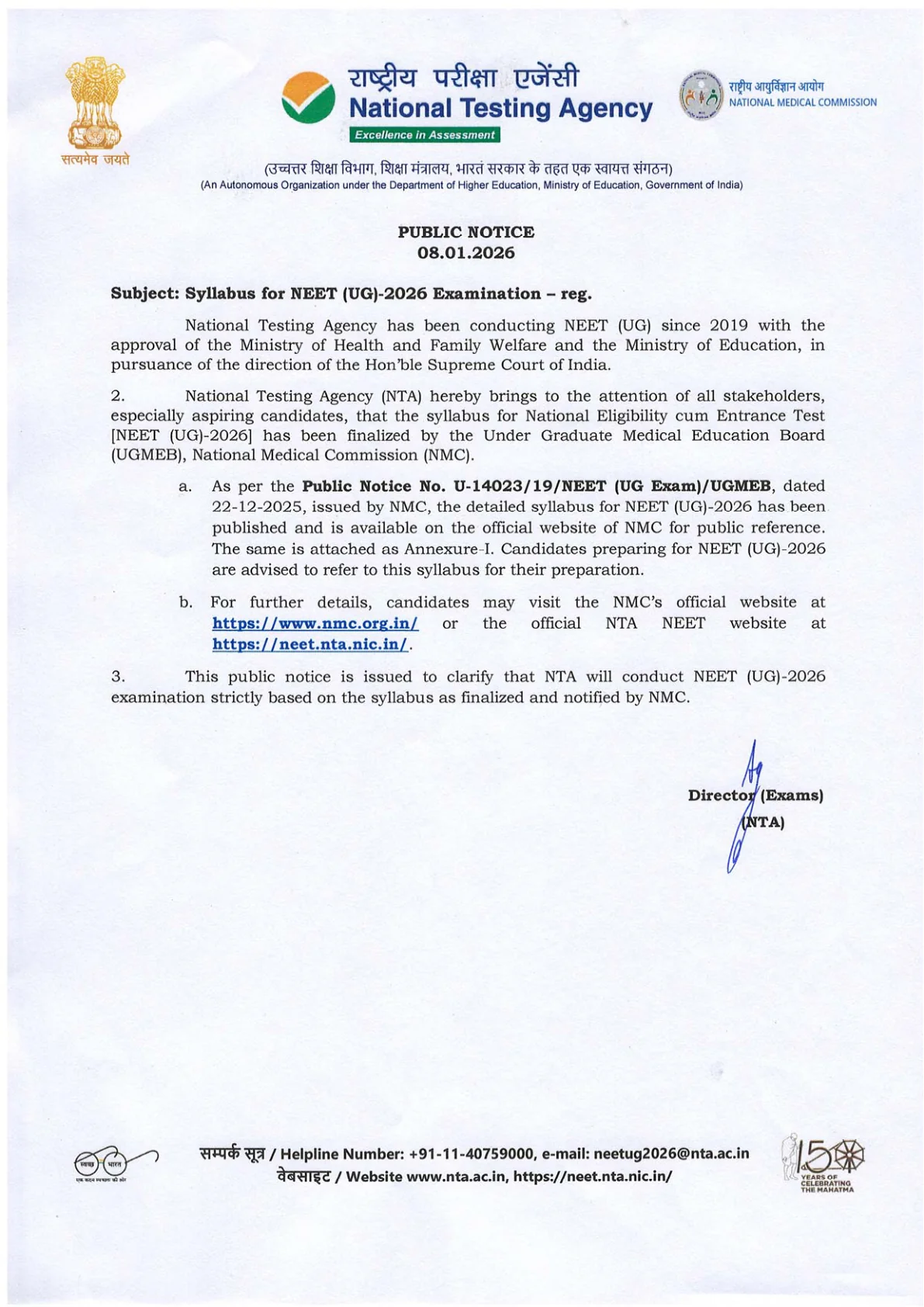
NEET UG 2026 aspirants usually want three things first: the official syllabus PDF, a clean subject-wise topic list, and clarity on whether anything has changed this year. For 2026, the syllabus has been finalized by the Under Graduate Medical Education Board under the National Medical Commission, while the National Testing Agency has published the official document and bulletin for candidates. The safest approach is to study from the official PDF only and use the NTA website for all exam-related updates.
The prescribed syllabus covers Physics, Chemistry, and Biology, with Biology split across Botany and Zoology in the exam paper. The NEET UG 2026 bulletin confirms that the paper will have 180 compulsory questions to be attempted in 180 minutes, and the subject distribution remains 45 questions each from Physics and Chemistry and 90 questions from Biology. That makes the syllabus document the base checklist for study planning, revision, and mock test alignment.
This article organizes the official syllabus into a practical format. You can use it to download the PDF, understand subject-wise units quickly, check the paper pattern connected to the syllabus, and avoid relying on unofficial chapter lists or random deleted-topic claims.
Official NEET UG 2026 syllabus PDF
The official NEET UG 2026 syllabus has been finalized by the Under Graduate Medical Education Board under the National Medical Commission and is available through NTA. Candidates should use the official PDF and the NEET documents page as the primary reference for preparation.
You can access the syllabus from the official links here: NEET UG 2026 syllabus PDF and NEET documents page.
| Item | Details |
|---|---|
| Exam | NEET UG 2026 |
| Syllabus finalised by | UGMEB under National Medical Commission |
| Exam conducted by | National Testing Agency |
| Academic session referred in the notice | 2026-27 |
NEET UG 2026 syllabus overview
The official syllabus is built around three core subjects: Physics, Chemistry, and Biology. In the actual paper, Biology is tested as Botany and Zoology together. For quick planning, use the syllabus as a unit-level checklist instead of relying only on chapter names from coaching material.
| Subject | Official coverage | Question count in exam | Marks |
|---|---|---|---|
| Physics | 20 units including experimental skills | 45 | 180 |
| Chemistry | 20 units across physical, inorganic, organic, and practical chemistry | 45 | 180 |
| Biology | 10 units covering plant biology, human physiology, genetics, biotechnology, and ecology | 90 | 360 |
| Total | Full prescribed NEET syllabus | 180 | 720 |
This overview is useful for deciding subject balance, but your real preparation should still follow the unit-wise syllabus PDF.
What is new in the NEET UG 2026 syllabus
The official NEET UG 2026 bulletin states that there is no change in the syllabus compared with the previous year. That means candidates should not wait for a separate revised chapter list unless a later official notice says otherwise.
One useful clarification in the official bulletin relates to Biology Unit 2. A wording issue involving the phrase about an insect and frog has been clarified in the syllabus FAQ. So, while the syllabus itself remains the same, candidates should read official clarifications carefully instead of following screenshots or forwarded notes.
- No change in the syllabus from the previous year.
- Prepare strictly from the official PDF uploaded on the official NEET and NTA platforms.
- Use the bulletin FAQ for any clarification-based confusion.
NEET UG 2026 Physics syllabus
The Physics syllabus moves from foundational mechanics to modern physics and practical skills. It includes both Class 11 and Class 12 areas, so students should prepare conceptually and not treat the paper as formula-only.
- Unit 1: Physics and Measurement
- Unit 2: Kinematics
- Unit 3: Laws of Motion
- Unit 4: Work, Energy, and Power
- Unit 5: Rotational Motion
- Unit 6: Gravitation
- Unit 7: Properties of Solids and Liquids
- Unit 8: Thermodynamics
- Unit 9: Kinetic Theory of Gases
- Unit 10: Oscillations and Waves
- Unit 11: Electrostatics
- Unit 12: Current Electricity
- Unit 13: Magnetic Effects of Current and Magnetism
- Unit 14: Electromagnetic Induction and Alternating Currents
- Unit 15: Electromagnetic Waves
- Unit 16: Optics
- Unit 17: Dual Nature of Matter and Radiation
- Unit 18: Atoms and Nuclei
- Unit 19: Electronic Devices
- Unit 20: Experimental Skills
The official Physics syllabus specifically includes practical-style familiarity such as vernier calipers, screw gauge, simple pendulum, metre scale, Young's modulus, surface tension, diode characteristics, and related observations. Do not skip these just because they look like lab content.
NEET UG 2026 Chemistry syllabus
The Chemistry syllabus is divided into physical, inorganic, organic, and practical chemistry. This is important because NEET questions often shift between direct theory, application, and statement-based concepts across all three branches.
- Unit 1: Some Basic Concepts in Chemistry
- Unit 2: Atomic Structure
- Unit 3: Chemical Bonding and Molecular Structure
- Unit 4: Chemical Thermodynamics
- Unit 5: Solutions
- Unit 6: Equilibrium
- Unit 7: Redox Reactions and Electrochemistry
- Unit 8: Chemical Kinetics
- Unit 9: Classification of Elements and Periodicity in Properties
- Unit 10: P-Block Elements
- Unit 11: d- and f- Block Elements
- Unit 12: Coordination Compounds
- Unit 13: Purification and Characterisation of Organic Compounds
- Unit 14: Some Basic Principles of Organic Chemistry
- Unit 15: Hydrocarbons
- Unit 16: Organic Compounds Containing Halogens
- Unit 17: Organic Compounds Containing Oxygen
- Unit 18: Organic Compounds Containing Nitrogen
- Unit 19: Biomolecules
- Unit 20: Principles Related to Practical Chemistry
Within these units, the official syllabus explicitly includes areas such as mole concept and stoichiometry, atomic theory, thermodynamics, equilibrium, electrochemistry, kinetics, periodicity, p-block, coordination compounds, hydrocarbons, alcohols, phenols, ethers, aldehydes, ketones, carboxylic acids, amines, biomolecules, and practical chemistry principles.
NEET UG 2026 Biology syllabus
The Biology syllabus remains the largest part of the NEET paper and covers both core life science concepts and application-based human welfare and biotechnology themes. Because Biology carries 90 questions, it deserves the largest study share in most preparation plans.
- Unit 1: Diversity in Living World
- Unit 2: Structural Organisation in Animals and Plants
- Unit 3: Cell Structure and Function
- Unit 4: Plant Physiology
- Unit 5: Human Physiology
- Unit 6: Reproduction
- Unit 7: Genetics and Evolution
- Unit 8: Biology and Human Welfare
- Unit 9: Biotechnology and Its Applications
- Unit 10: Ecology and Environment
The official Biology syllabus covers taxonomy and classification, morphology and anatomy of plants, animal tissues, cell structure, biomolecules, enzymes, plant physiology, breathing and circulation, excretion, locomotion, neural and endocrine control, reproduction, heredity, molecular basis of inheritance, evolution, health and disease, microbes in human welfare, recombinant DNA technology, biodiversity, ecosystems, and conservation.
For Biology Unit 2, the official bulletin also carries a clarification on the wording related to an insect and a frog. That note is worth checking if you are making your own chapter checklist from the PDF.
NEET UG 2026 paper pattern linked to the syllabus
The syllabus tells you what to study, but the bulletin tells you how it will be asked. For 2026, NTA has confirmed the standard 180-question format with all questions compulsory.
| Component | Official pattern |
|---|---|
| Mode | Pen and paper |
| Duration | 180 minutes |
| Physics | 45 questions, 180 marks |
| Chemistry | 45 questions, 180 marks |
| Biology | 90 questions, 360 marks |
| Total | 180 questions, 720 marks |
| Marking scheme | +4 for correct answer, -1 for incorrect answer, 0 for unanswered |
The official bulletin also says the question paper will be offered in 13 languages. When a translation issue arises, the English version is treated as final. That matters if you are preparing from bilingual notes.
How to download the official NEET UG 2026 syllabus PDF
- Open the official NEET documents page.
- Find the entry named NEET UG 2026 syllabus.
- Open the accessible PDF or the official PDF notice.
- Save the PDF and create a subject-wise checklist from the unit list.
- Cross-check any future change only on neet.nta.nic.in.
For direct access, candidates can also use the official PDF hosted by NTA: download NEET UG 2026 syllabus PDF.
How to use the syllabus for preparation
A syllabus PDF is most useful when it becomes a working checklist. Instead of reading it once and forgetting it, break it into units, subtopics, revision status, and mock test coverage.
- Map every official unit to the exact chapters you study.
- Mark topics that are practical or observation based, especially in Physics and Chemistry.
- Revise Biology line by line because many questions come from definition-level and process-level reading.
- Do not assume a chapter is outside syllabus only because a coaching handout says so.
- Use the official unit list before each mock test to identify coverage gaps.
- Keep one printed or saved copy of the PDF for last-month revision tracking.
This approach helps you avoid both under-preparation and wasted time on topics that are not clearly prescribed.
Important official notes and basic eligibility context
Although this page is focused on syllabus, candidates often need a quick eligibility check while planning preparation. The official bulletin says NEET UG 2026 is the common entrance test for admission to undergraduate medical education and related courses covered under the relevant laws and regulations.
- Minimum age: 17 years on or before 31 December of the year of admission.
- Academic base for most candidates: 10+2 or equivalent with Physics, Chemistry, Biology or Biotechnology, and English.
- Class 12 students appearing in 2026 can also apply, subject to meeting the final eligibility rules in the bulletin.
Use the syllabus for study planning, but always confirm admission eligibility, category rules, and counselling-related conditions from the official information bulletin and the relevant counselling authorities.
Official Links
Frequently Asked Questions
No. The official NEET UG 2026 bulletin states that there is no change in the syllabus compared with the previous year.
The syllabus was finalized by the Under Graduate Medical Education Board under the National Medical Commission, and it is available through the official NTA and NEET platforms.
The syllabus includes Physics, Chemistry, and Biology. In the exam paper, Biology is tested as Botany and Zoology together.
The official syllabus carries 20 units in Physics, 20 units in Chemistry, and 10 units in Biology.
You can download it from the official NEET documents page or directly from the official NTA PDF link.
Yes. Physics includes experimental skills, Chemistry includes principles related to practical chemistry, and Biology also links some topics with the relevant practical syllabus.
Yes. Candidates appearing in Class 12 in 2026 can prepare from this syllabus, but they must still satisfy the final eligibility conditions given in the official bulletin.
Yes. The official bulletin includes a clarification that the wording should be read as referring to an insect and a frog.