
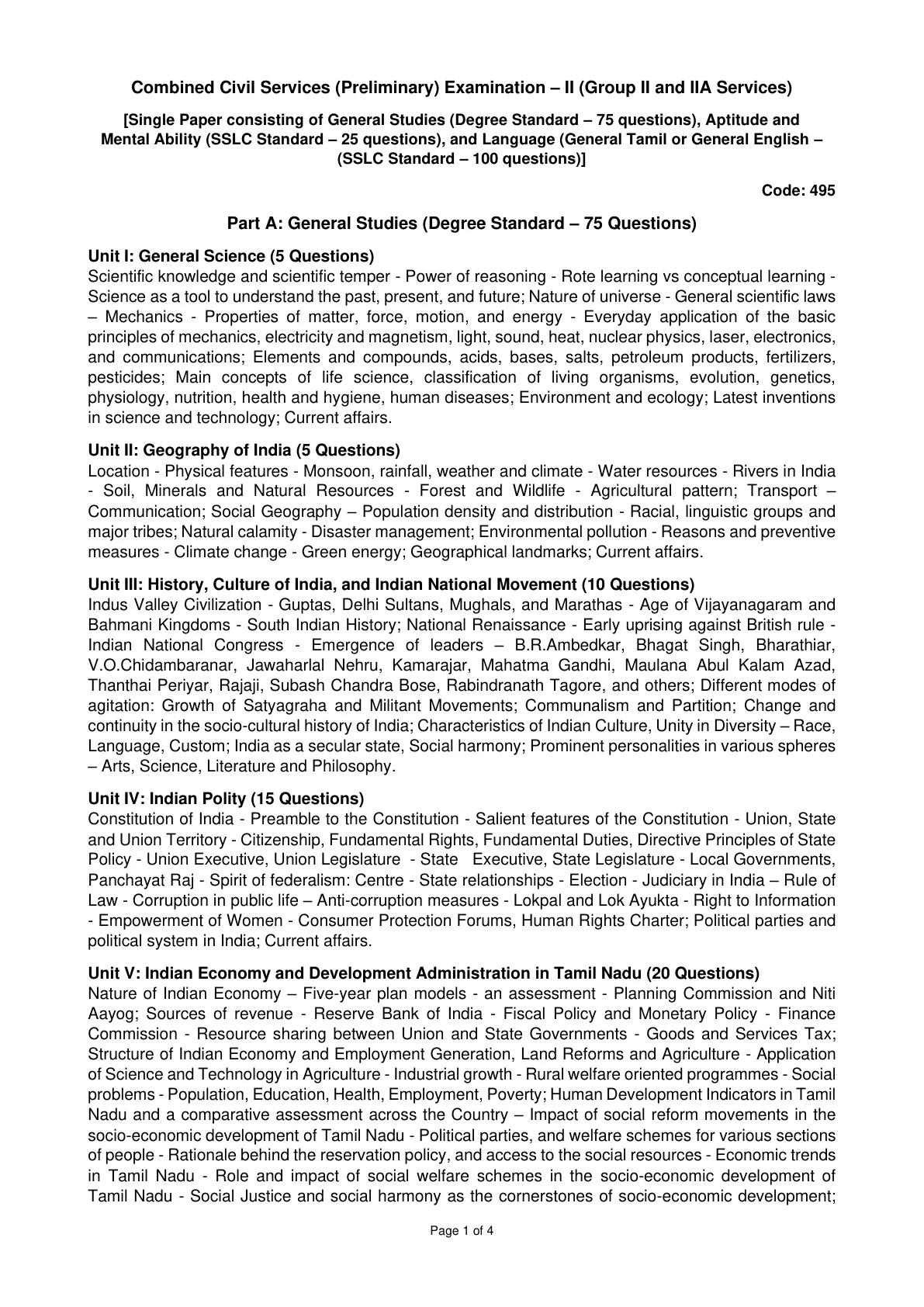
TNPSC Group 2 syllabus 2026 is not a single paper outline that can be understood in isolation. The examination is officially conducted as Combined Civil Services Examination-II for Group II and Group IIA Services, with one common preliminary paper and then separate mains for Group II and Group IIA. That means a serious candidate has to understand not only the prelims syllabus, but also which mains pattern applies to the posts they are targeting.
At the time of writing, TNPSC has published the 2026 annual planner, but the detailed Group II/IIA notification for the 2026 cycle has not yet been released. The planner says the syllabus and scheme remain subject to modification until the date of notification. So the most reliable approach is to follow the latest official syllabus PDFs currently available on the TNPSC website: Code 495 for the common prelims, Code 469 for Group II mains, and Code 583 for Group IIA mains.
This article is built around those official documents. It explains the latest exam pattern, the exact unit-wise weightage for prelims, the structure of Group II descriptive mains, the updated Group IIA objective mains pattern, and how to use the official syllabus PDFs without wasting time on outdated summaries or coaching-style shortcuts.
Latest status of TNPSC Group 2 syllabus 2026
The detailed TNPSC Group 2 and Group 2A notification for the 2026 cycle is not yet out. TNPSC's annual planner for 2026 lists Combined Civil Services Examination-II (Group II and IIA Services) with a tentative notification date of 11.08.2026 and a tentative preliminary examination date of 25.10.2026.
Until that notification is issued, candidates should prepare using the latest official syllabus PDFs currently hosted by TNPSC. The annual planner also states that the syllabus and scheme of examination are subject to modification until the date of notification. So the safest strategy is to study the current official syllabus now and verify it again immediately after the 2026 notification is published.
Official syllabus PDFs you should follow
For TNPSC Group 2 2026 preparation, use only the latest official TNPSC documents. The most important PDF set is straightforward.
| Document | Code | Use |
|---|---|---|
| Common Preliminary Syllabus for Group II and IIA | 495 | Use for the shared prelims paper for both Group II and Group IIA posts |
| Group II Main Syllabus | 469 | Use if you are targeting Group II services with descriptive Paper II |
| Group IIA Main Syllabus | 583 | Use if you are targeting Group IIA services with objective CBT Paper II |
| Group II and IIA Notification PDF | Notification No. 11/2025 | Use for the latest official scheme, qualifying marks, selection basis and annexures |
This distinction matters because many third-party pages still mix old Group IIA patterns with the current one. For current preparation, follow the official code 583 syllabus for Group IIA mains.
TNPSC Group 2 2026 exam pattern at a glance
| Stage | Paper | Pattern | Marks | Duration | Minimum Qualifying Marks |
|---|---|---|---|---|---|
| Preliminary Examination | Single Paper | 100 Language questions, 75 General Studies questions, 25 Aptitude and Mental Ability questions; objective OMR | 300 | 3 hours | 90 |
| Group II Main Examination | Paper I | Tamil Eligibility Test, descriptive, SSLC standard | 100 | 3 hours | 40 |
| Group II Main Examination | Paper II | General Studies, descriptive, degree standard | 300 | 3 hours | 90 |
| Group IIA Main Examination | Paper I | Tamil Eligibility Test, descriptive, SSLC standard | 100 | 3 hours | 40 |
| Group IIA Main Examination | Paper II | 150 General Studies questions and 50 General Intelligence and Reasoning questions; objective CBT | 300 | 3 hours | 90 |
The prelims paper is only a screening test. Its marks are not counted for final ranking. In both Group II and Group IIA mains, Paper I is qualifying in nature, and Paper II is the score that determines ranking for final selection, subject to reservation and further verification stages.
TNPSC also states that the General Studies questions in prelims and mains are set in both Tamil and English.
TNPSC Group 2 preliminary syllabus structure
The preliminary examination is common for both Group II and Group IIA services. It is made up of three parts.
| Part | Subject | Standard | Questions |
|---|---|---|---|
| Part A | General Studies | Degree | 75 |
| Part B | Aptitude and Mental Ability | SSLC | 25 |
| Part C | Language (General Tamil or General English) | SSLC | 100 |
| Total | Single Paper | Mixed | 200 |
Within General Studies, TNPSC has indicated unit-wise question distribution. That makes the prelims syllabus more predictable than many candidates assume.
| General Studies Unit | Questions |
|---|---|
| General Science | 5 |
| Geography of India | 5 |
| History, Culture of India and Indian National Movement | 10 |
| Indian Polity | 15 |
| Indian Economy and Development Administration in Tamil Nadu | 20 |
| History, Culture, Heritage and Socio-Political Movements in Tamil Nadu | 20 |
Current affairs is not treated as a separate isolated block. It is woven into the official units, so preparation has to stay unit-linked.
Unit-wise preliminary general studies topics
The General Studies portion of the TNPSC Group 2 prelims is broad but clearly structured. The official focus areas are as follows.
- General Science: basic science concepts, scientific temper, mechanics, electricity, magnetism, light, sound, heat, electronics, chemistry, life science, health, environment, ecology, recent inventions and current affairs.
- Geography of India: physical features, monsoon, climate, water resources, rivers, minerals, forests, agriculture, transport, social geography, disaster management, environmental pollution, climate change and geographical landmarks.
- History, Culture of India and Indian National Movement: Indus Valley Civilization, major dynasties, South Indian history, national renaissance, Congress movement, major leaders, communalism, partition and Indian cultural continuity.
- Indian Polity: Constitution, rights, duties, directive principles, Union and State structure, local government, judiciary, anti-corruption institutions, right to information, human rights and political system.
- Indian Economy and Development Administration in Tamil Nadu: planning, NITI Aayog, RBI, fiscal and monetary policy, agriculture, industrial growth, poverty, health, education, welfare schemes, social justice, e-governance and current socio-economic issues.
- History, Culture, Heritage and Socio-Political Movements in Tamil Nadu: Tamil society, archaeology, Sangam literature, Thirukkural, role of Tamil Nadu in the freedom struggle, Justice Party, Self-Respect Movement, Dravidian Movement, Thanthai Periyar and Perarignar Anna.
The last two units carry the highest weight, so preparation for Tamil Nadu-specific polity, economy, history and socio-political movements should not be treated as a side topic.
Aptitude, reasoning and language syllabus in prelims
The Aptitude and Mental Ability section carries 25 questions and is split into two parts.
| Component | Questions | Main Topics |
|---|---|---|
| Aptitude | 15 | Simplification, percentage, HCF, LCM, ratio and proportion, simple interest, compound interest, area, volume, time and work |
| Reasoning | 10 | Logical reasoning, puzzles, dice, visual reasoning, alpha-numeric reasoning, number series |
The 100-question language part can be attempted either as General Tamil or General English. General English is officially divided into Grammar, Vocabulary, Writing Skills, Technical Terms, Reading Comprehension, Translation and Literary Works. General Tamil is also structured at SSLC level around grammar, vocabulary, writing, technical terms, comprehension, translation and literature-based school-level content.
Because the language block alone accounts for half of the prelims paper, it is a scoring area only if prepared as a full paper. Candidates should not postpone language preparation until the last month.
Group II mains syllabus 2026
Group II services have a separate mains pattern after the common prelims. Paper I is the Tamil Eligibility Test and is only qualifying. Paper II is a descriptive General Studies paper of 300 marks at degree standard.
| Unit | Topic | Marks |
|---|---|---|
| Unit I | Modern History of India with specific reference to Tamil Nadu | 40 |
| Unit II | Tamil Society, Culture and Heritage | 30 |
| Unit III | Social Issues in India with specific reference to Tamil Nadu | 50 |
| Unit IV | Science and Technology in Development | 40 |
| Unit V | Constitution, Polity and Governance in India with specific reference to Tamil Nadu | 60 |
| Unit VI | Geography of India, Environment, Biodiversity and Disaster Management in India with specific reference to Tamil Nadu | 40 |
| Unit VII | Indian Economy with specific reference to Tamil Nadu | 40 |
The latest notification also gives a question paper pattern for Group II Paper II. Part A has 9 compulsory 10-mark questions. Part B has 5 questions from Unit II, of which 3 must be answered. Part C has six sections of 15-mark questions, and in each section the candidate answers 2 out of 3 questions. This means Group II mains is not just about content coverage; it also demands answer writing, structure, and time discipline.
The Common Tamil Eligibility Test in mains must still be cleared first. TNPSC evaluates Paper II only if the candidate secures the minimum qualifying marks in Paper I.
Group IIA mains syllabus 2026
Group IIA services now follow the updated mains pattern in which Paper I is the Tamil Eligibility Test and Paper II is an objective Computer Based Test. The latest official Group IIA mains syllabus is Code 583.
| Paper II Component | Questions | Standard |
|---|---|---|
| Part A General Studies | 150 | Degree |
| Part B General Intelligence and Reasoning | 50 | SSLC |
| Total | 200 | Mixed |
The General Studies part is distributed unit-wise as follows.
| Unit | Topic | Questions |
|---|---|---|
| Unit I | Modern History of Tamil Nadu, Tamil Society and Culture and Heritage | 30 |
| Unit II | Administration of States with reference to Tamil Nadu | 45 |
| Unit III | Science and Technology in Development | 20 |
| Unit IV | Tamil Nadu Economy and Social Issues in Tamil Nadu | 30 |
| Unit V | Geography of Tamil Nadu, Environment, Biodiversity and Disaster Management in Tamil Nadu | 25 |
The General Intelligence and Reasoning part includes analogy, classification, coding-decoding, relationship concepts, puzzles, dice, direction and distance, logical Venn diagrams, alpha-numeric reasoning, arithmetical reasoning, statement verification, similarities and differences, calendar, permutation and combination, missing characters, logical reasoning, figural series, numerical operations, symbolic operations, word building, statement and conclusion, address matching, mirror images, embedded figures, visual reasoning, figural classification and square completion.
Group II and Group IIA differences you should not mix up
| Point | Group II | Group IIA |
|---|---|---|
| Prelims | Common with Group IIA | Common with Group II |
| Main Paper I | Tamil Eligibility Test, qualifying | Tamil Eligibility Test, qualifying |
| Main Paper II | Descriptive General Studies | Objective CBT with General Studies and Reasoning |
| Main Paper II Nature | Answer writing based | MCQ based |
| Main Paper II Weight | 300 marks | 300 marks |
| Ranking Basis | Paper II marks | Paper II marks |
This is where many candidates lose direction. They prepare one common mains strategy even though the papers are not the same. Group II needs strong descriptive writing and issue-based presentation. Group IIA needs precise objective preparation with speed and accuracy in a CBT format.
So after prelims preparation, the right move is to split your plan according to the services you realistically target, instead of carrying the same notebook strategy into both mains patterns.
How to prepare with the official syllabus PDF
Start by printing or saving the three official syllabus documents separately and making a checklist unit by unit. Do not study from broad subject names alone. TNPSC frequently asks from the exact phrasing of its own syllabus, especially in Tamil Nadu-specific administration, welfare schemes, polity and socio-political movements.
- Finish the common prelims foundation first because both Group II and Group IIA depend on it.
- Treat the 100-question language paper as a major scoring block, not as an afterthought.
- Prepare Tamil Nadu-specific units with equal seriousness as national topics because they carry heavy weight.
- Begin Tamil Eligibility Test preparation early, even if it is only qualifying, because failure there blocks evaluation of Paper II.
- For Group II mains, practice structured answers in 100-word and 200-word formats.
- For Group IIA mains, convert each unit into MCQ-friendly notes and revise through repeated objective practice.
- Once the 2026 notification is published, compare it with your working syllabus copy and update any changes immediately.
If you study directly from the official structure rather than from summary notes alone, your preparation becomes cleaner, more targeted and easier to revise.
Official Links
Frequently Asked Questions
No. The detailed 2026 Group II and Group IIA notification is not yet released. TNPSC has only published the 2026 annual planner with tentative dates.
Yes. Group II and Group IIA share the same preliminary examination and the same prelims syllabus.
Yes. After the common prelims, Group II and Group IIA have separate mains patterns and separate syllabus documents.
Yes. Paper I in the mains is the Tamil Eligibility Test for both Group II and Group IIA, and it is qualifying in nature.
The prelims has 200 questions: 100 from Language, 75 from General Studies and 25 from Aptitude and Mental Ability.
Prelims is only a screening test. In mains, Paper I is qualifying and Paper II marks determine ranking for final selection.
Download the official prelims syllabus PDF Code 495, Group II mains syllabus PDF Code 469, and Group IIA mains syllabus PDF Code 583 from the TNPSC website.